Growing Food and Generating Clean Energy Together
Introduction
The twenty-first century is defined by a convergence of global challenges. The world must produce more food to feed a growing population, generate significantly more clean energy to reduce greenhouse gas emissions, conserve increasingly scarce water resources, and build resilience against climate change—all while protecting biodiversity and minimizing competition for land (IPCC, 2023). Traditionally, these objectives have often competed for the same natural resources. Agricultural land is needed to grow crops and raise livestock, while renewable energy projects require large areas for solar installations. This apparent conflict has prompted researchers and policymakers to ask an important question: Can the same land produce both food and clean electricity simultaneously?
Agrivoltaics provides a compelling answer. By integrating solar photovoltaic (PV) systems with agricultural production, agrivoltaics enables land to serve multiple purposes at once. Rather than replacing farmland with solar farms, this innovative approach combines agriculture and renewable energy in a mutually beneficial system. Today, agrivoltaics is increasingly recognized as one of the most promising climate-smart land-use strategies capable of addressing food security, energy transition, water conservation, and rural economic development simultaneously (Barron-Gafford et al., 2019; Dupraz et al., 2011).
What is Agrivoltaics?
Agrivoltaics—sometimes called agrovoltaics, solar sharing, or dual-use solar agriculture—is the intentional co-location of agricultural production and solar photovoltaic energy generation on the same piece of land (Dupraz et al., 2011). Unlike conventional solar farms that exclude farming activities, agrivoltaic systems are specifically designed to allow crops, livestock, pollinator habitats, or other agricultural enterprises to coexist with elevated or strategically spaced solar panels.
The concept was first introduced by French and German researchers who recognized that plants do not utilize all incoming solar radiation efficiently. While crops require sunlight for photosynthesis, excessive radiation often contributes to heat stress and water loss rather than increased productivity. By harvesting part of this sunlight to generate electricity while allowing sufficient light for crop growth, agrivoltaic systems improve the overall productivity of agricultural landscapes (Dupraz et al., 2011).
Today, agrivoltaic projects exist across Europe, the United States, Japan, China, Australia, and increasingly throughout Africa, where abundant solar resources and expanding agricultural needs create significant opportunities for integrated land management.
Why Agrivoltaics Matters
Global food demand is projected to increase substantially over the coming decades due to population growth and changing consumption patterns. Simultaneously, countries worldwide are rapidly expanding renewable energy generation to meet climate targets established under international agreements such as the Paris Agreement (IPCC, 2023).
These parallel transitions create increasing competition for land. Converting productive farmland into conventional solar farms may reduce agricultural production, while maintaining agriculture alone limits opportunities for renewable energy expansion. Agrivoltaics eliminates this trade-off by enabling food and electricity production on the same land area, thereby improving overall land-use efficiency (Barron-Gafford et al., 2019).
This integrated approach is particularly valuable in regions where agricultural land is limited, energy access remains inadequate, or climate change threatens agricultural productivity.
How Agrivoltaic Systems Work
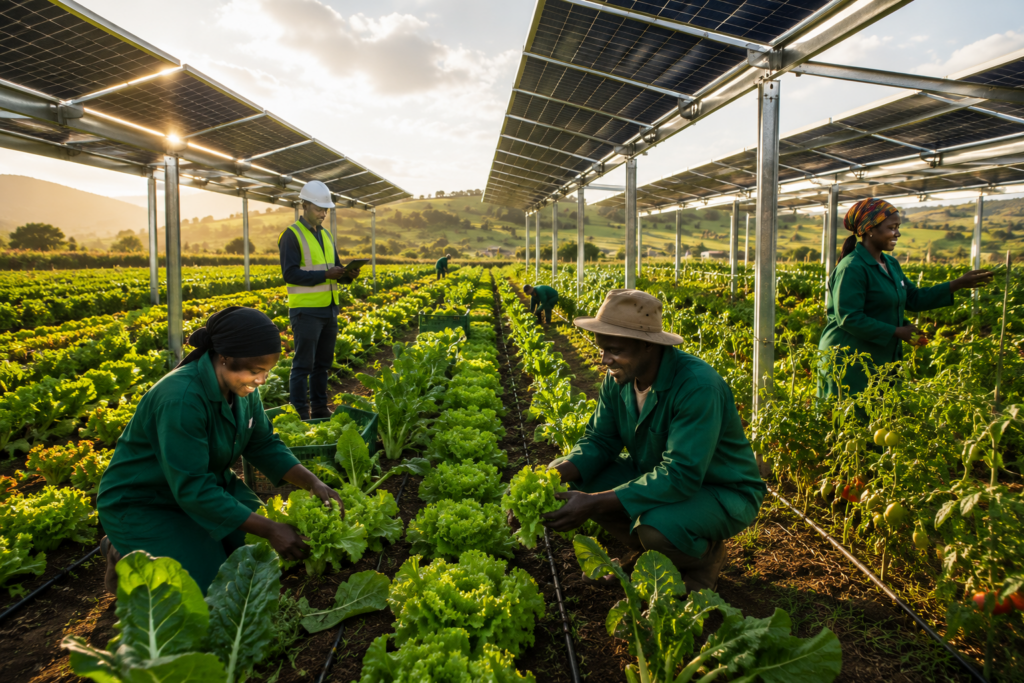
Agrivoltaic systems consist of elevated solar panels installed above or between agricultural production areas. Their design varies depending on crop type, livestock operations, climate, machinery requirements, and solar energy objectives.
Several common configurations have emerged:
- Elevated fixed solar arrays, which allow tractors and farm equipment to operate beneath the panels.
- Vertical bifacial solar panels, arranged in rows to maximize both sunlight transmission and electricity generation.
- Solar greenhouses, where photovoltaic modules are integrated into greenhouse roofs.
- Single-axis tracking systems, which rotate throughout the day to optimize electricity production while controlling shade patterns.
The amount of shade reaching crops depends on panel spacing, height, orientation, and tracking strategy. Successful agrivoltaic systems carefully balance crop light requirements with electricity generation objectives, ensuring that neither function compromises the other (Adeh et al., 2019).
Benefits for Crop Production
Contrary to the assumption that shading always reduces crop yields, many crops benefit from moderate shading, particularly in hot and water-limited environments. Excessive solar radiation often increases leaf temperature, accelerates evapotranspiration, and reduces photosynthetic efficiency during periods of extreme heat.
Solar panels create a moderated microclimate by lowering daytime temperatures, reducing direct solar exposure, and decreasing wind speed beneath the arrays. These conditions often reduce crop heat stress while maintaining adequate sunlight for photosynthesis (Barron-Gafford et al., 2019).
Leafy vegetables such as lettuce, spinach, kale, and herbs frequently perform well under partial shading. Certain berries, peppers, tomatoes, forage crops, and medicinal plants may also benefit depending on local environmental conditions. Researchers have documented improved crop quality, delayed water stress, and in some cases increased yields under carefully designed agrivoltaic systems (Adeh et al., 2019).
Improving Water Efficiency
Water scarcity represents one of the greatest threats to global agriculture. Approximately 70 percent of global freshwater withdrawals are used for irrigation, making agriculture the world’s largest water consumer (FAO, 2021).
Agrivoltaics contributes directly to water conservation by reducing soil evaporation. Shaded soils remain cooler and retain moisture for longer periods, allowing crops to maintain growth while requiring less irrigation. Reduced evapotranspiration also improves overall water-use efficiency, particularly in semi-arid and drought-prone environments (Barron-Gafford et al., 2019).
As climate change increases the frequency of droughts and extreme heat events, these water-saving benefits become increasingly valuable for maintaining agricultural resilience.
Clean Energy Generation
While supporting agriculture, agrivoltaic systems simultaneously generate renewable electricity through photovoltaic technology. Solar panels convert sunlight directly into electricity without producing greenhouse gas emissions during operation.
The generated electricity can serve multiple purposes, including:
- Powering irrigation pumps.
- Operating cold storage facilities.
- Supplying electricity to homes and rural communities.
- Supporting agro-processing industries.
- Charging electric farm equipment.
- Exporting electricity to national power grids.
This diversification strengthens farm resilience while reducing dependence on fossil fuels and supporting national climate mitigation goals (IPCC, 2023).
Livestock and Biodiversity Benefits
Agrivoltaics extends beyond crop production. Elevated solar arrays can accommodate grazing livestock such as sheep, goats, cattle, and poultry. Animals benefit from shade during hot weather, reducing heat stress while naturally controlling vegetation beneath the panels.
Biodiversity also benefits when agrivoltaic systems incorporate native grasses and flowering plants. These habitats support pollinators—including bees and butterflies—as well as beneficial insects and birds that contribute to ecosystem functioning and agricultural productivity.
Rather than creating biologically simplified landscapes, well-designed agrivoltaic systems can enhance ecological diversity while maintaining productive agriculture (Barron-Gafford et al., 2019).
Economic Opportunities for Farmers
Agrivoltaics provides farmers with an additional and often more stable source of income. Agricultural revenues can fluctuate considerably due to weather, pests, diseases, and market conditions. Electricity generation diversifies farm income and reduces financial risk.
Economic opportunities include:
- Selling electricity to utilities.
- Leasing land for agrivoltaic development.
- Community-owned renewable energy projects.
- Reduced irrigation costs.
- Lower vegetation management expenses.
- Increased farm resilience against climate variability.
This diversified revenue model may improve long-term farm viability while supporting rural economic development.
Agrivoltaics and Climate Change
Climate change is increasing temperatures, altering rainfall patterns, intensifying droughts, and threatening agricultural productivity worldwide (IPCC, 2023). Agrivoltaics contributes to both climate mitigation and climate adaptation.
From a mitigation perspective, renewable solar energy reduces greenhouse gas emissions by replacing fossil fuel-based electricity generation.
From an adaptation perspective, moderated microclimates, improved soil moisture retention, reduced irrigation demand, and diversified farm income help agricultural systems withstand increasing climate variability.
Consequently, agrivoltaics is increasingly viewed as a climate-smart agricultural practice capable of enhancing resilience while supporting sustainable development.
Opportunities for Africa
Africa possesses some of the world’s highest solar energy potential while simultaneously facing significant challenges related to food insecurity, energy access, water scarcity, and climate change. These interconnected challenges make agrivoltaics particularly relevant across the continent.
Potential applications include:
- Solar-powered irrigation systems for smallholder farmers.
- Community agrivoltaic farms.
- Rural electrification projects.
- School demonstration gardens.
- Livestock grazing beneath elevated solar panels.
- Water pumping and storage.
- Agricultural research and climate-smart extension services.
Agrivoltaics can support multiple Sustainable Development Goals (SDGs), including zero hunger (SDG 2), affordable and clean energy (SDG 7), climate action (SDG 13), clean water and sanitation (SDG 6), and decent work and economic growth (SDG 8).
The Future of Agrivoltaics
The future of agrivoltaics lies not only in improved engineering but also in systems integration. Modern agrivoltaic farms increasingly incorporate weather stations, soil moisture sensors, drones, satellite imagery, artificial intelligence, Internet of Things (IoT) devices, and digital twins to optimize agricultural and energy performance simultaneously.
Researchers are also expanding agrivoltaic applications beyond crop production to include livestock systems, aquaculture, agroforestry, pollinator conservation, and integrated Food-Energy-Water (FEW) systems. These innovations position agrivoltaics as an important component of convergence science, where engineering, agriculture, ecology, economics, data science, and policy work together to solve complex sustainability challenges.
Conclusion
Agrivoltaics represents a transformative approach to sustainable land management by demonstrating that agriculture and renewable energy need not compete for space. Instead, they can complement one another to improve land productivity, conserve water, strengthen food security, generate clean electricity, support biodiversity, and enhance climate resilience.
As countries seek innovative solutions to address the interconnected challenges of climate change, energy transition, and sustainable food production, agrivoltaics offers a practical example of integrated thinking in action. By producing food and clean energy together on the same land, agrivoltaics is helping shape a future where environmental sustainability, economic prosperity, and resilient communities can grow side by side.
References
Adeh, E. H., Good, S. P., Calaf, M., & Higgins, C. W. (2019). Solar PV power potential is greatest over croplands. Scientific Reports, 9, 11442.
Barron-Gafford, G. A., Pavao-Zuckerman, M. A., Minor, R. L., et al. (2019). Agrivoltaics provide mutual benefits across the food–energy–water nexus in drylands. Nature Sustainability, 2(9), 848–855.
Dupraz, C., Marrou, H., Talbot, G., Dufour, L., Nogier, A., & Ferard, Y. (2011). Combining solar photovoltaic panels and food crops for optimising land use: Towards new agrivoltaic schemes. Renewable Energy, 36(10), 2725–2732.
Food and Agriculture Organization of the United Nations (FAO). (2021). The State of the World’s Land and Water Resources for Food and Agriculture – Systems at Breaking Point. Rome: FAO.
Intergovernmental Panel on Climate Change (IPCC). (2023). Climate Change 2023: Synthesis Report. Geneva, Switzerland: IPCC.

About the Author
Gabriel Sunday Ayayia
Founder, LIFEWS Foundation
Gabriel Sunday Ayayia is a researcher, educator, and systems innovator whose work focuses on agrivoltaics, climate resilience, food-water-energy systems, convergence science, artificial intelligence, and sustainable development. He is currently pursuing a PhD in Biological & Ecological Engineering at Oregon State University, where his research investigates agrivoltaics as a pathway to resilient food-energy-water systems.
Read Full Biography →