Introduction
Climate change is fundamentally altering the frequency, intensity, and duration of extreme weather events across the globe. Among the most significant of these extremes are heatwaves and droughts, which threaten human health, food production, water resources, ecosystems, infrastructure, and economic development. While each hazard can independently cause substantial damage, scientists increasingly recognize that they often occur together, interacting in ways that amplify their impacts. These interacting events are known as compound climate hazards and represent one of the fastest-growing areas of climate research (IPCC, 2023; Zscheischler et al., 2020).
The consequences of compound hazards are becoming increasingly evident worldwide. Extended heatwaves combined with prolonged drought have intensified wildfires across Australia, Europe, and North America, reduced agricultural productivity in Africa and Asia, strained water supplies in many cities, and increased mortality during extreme weather events. As global temperatures continue to rise, understanding these interconnected hazards has become essential for governments, researchers, communities, and industries seeking to build climate resilience.
This article explores the science behind heatwaves, droughts, and compound climate hazards, their impacts on society, and why integrated approaches are necessary for effective adaptation and risk reduction.
What is a Heatwave?
A heatwave is an extended period of abnormally high temperatures relative to the typical climate of a particular region. Although definitions vary among countries, heatwaves generally persist for several consecutive days or weeks and often include unusually high daytime and nighttime temperatures (IPCC, 2023).
Heatwaves are influenced by several factors, including:
- High atmospheric pressure systems.
- Reduced cloud cover.
- Low soil moisture.
- Persistent stagnant air masses.
- Climate change.
Unlike isolated hot days, heatwaves prevent the environment from cooling sufficiently at night. This prolonged exposure increases stress on humans, crops, livestock, infrastructure, and ecosystems.
Recent decades have witnessed a marked increase in both the frequency and intensity of heatwaves across nearly every continent. According to the Intergovernmental Panel on Climate Change (IPCC), human-induced climate change has made many recent extreme heat events significantly more likely and more severe (IPCC, 2023).
Understanding Drought
Unlike heatwaves, which develop rapidly, drought is a slow-onset hazard characterized by prolonged water deficits. Drought does not simply mean the absence of rainfall; rather, it reflects an imbalance between water supply and water demand over an extended period (Wilhite, 2000).
Scientists generally recognize four major categories of drought:
Meteorological Drought
Meteorological drought occurs when precipitation remains significantly below the long-term average for a region. It is often the earliest stage of drought development and serves as the initial trigger for other drought types.
Agricultural Drought
Agricultural drought develops when soil moisture becomes insufficient to meet crop water requirements. Even if some rainfall occurs, high evaporation and poor soil water retention may still create agricultural drought conditions.
Hydrological Drought
Hydrological drought affects rivers, lakes, reservoirs, wetlands, and groundwater systems. These impacts often appear weeks or months after meteorological drought begins because water storage systems respond more slowly than rainfall.
Socioeconomic Drought
Socioeconomic drought occurs when water shortages begin affecting human activities, including food production, public health, industry, transportation, recreation, and energy generation. This form of drought directly influences livelihoods and economic stability.
Each drought type reflects different components of the water cycle, emphasizing that drought is both a physical and societal phenomenon.
The Relationship Between Heatwaves and Drought
Heatwaves and drought are closely connected through interactions within the Earth’s water and energy cycles.
Under normal conditions, part of the incoming solar energy is used to evaporate water from soils and vegetation through evapotranspiration. This process naturally cools the land surface.
However, during drought conditions, soil moisture becomes depleted. Because less water is available for evaporation, more incoming solar energy is converted into sensible heat, causing land temperatures to increase (Miralles et al., 2019).
The resulting higher temperatures further increase evaporation demand, drying soils even more rapidly. This creates a positive feedback loop:
- Drought reduces soil moisture.
- Reduced soil moisture increases surface temperatures.
- Higher temperatures intensify heatwaves.
- Heatwaves accelerate soil drying.
- Drier soils further strengthen heatwaves.
This self-reinforcing cycle explains why droughts and heatwaves frequently occur together and why their combined impacts can become particularly severe.
What Are Compound Climate Hazards?
Traditionally, natural hazards have been studied individually. However, climate scientists increasingly recognize that hazards often interact in space and time.
Compound climate hazards refer to multiple climate-related events occurring simultaneously, sequentially, or in combination, producing impacts that exceed those caused by individual hazards alone (Zscheischler et al., 2020).
Examples include:
- Heatwaves occurring during prolonged drought.
- Heavy rainfall following wildfire.
- Storm surge combined with river flooding.
- Heatwaves coinciding with poor air quality.
- Drought occurring alongside high electricity demand.
These interacting hazards create cascading effects across multiple sectors, making risk management considerably more complex than addressing single hazards independently.
Impacts on Agriculture and Food Security
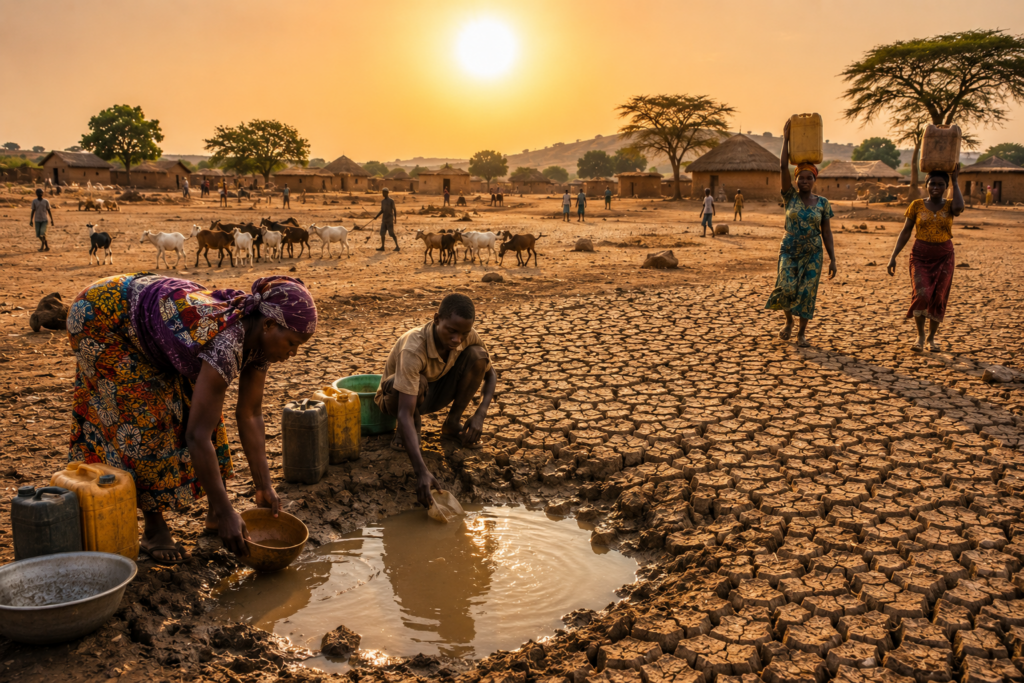
Agriculture is among the sectors most vulnerable to compound heat and drought events.
Plants require both sufficient water and favorable temperatures for healthy growth. During compound events, crops experience simultaneous heat stress and water stress. High temperatures accelerate plant respiration while reducing photosynthesis. Plants close their stomata to conserve water, limiting carbon uptake and slowing growth.
The combined effects often include:
- Reduced crop yields.
- Poor grain filling.
- Lower fruit quality.
- Increased pest and disease outbreaks.
- Crop failure under severe conditions.
Livestock are similarly affected. Heat stress reduces feed intake, milk production, reproductive performance, and weight gain while increasing mortality rates. Water shortages further reduce pasture availability and increase production costs.
Consequently, compound hazards threaten both local food security and global agricultural markets.
Water Resources Under Stress
Water resources become increasingly vulnerable during compound events.
Reduced rainfall lowers river flows, reservoir storage, and groundwater recharge. At the same time, high temperatures increase water demand from agriculture, households, industry, and ecosystems.
This imbalance creates competition among different water users.
Examples include:
- Farmers requiring irrigation.
- Cities demanding drinking water.
- Industries needing cooling water.
- Hydropower reservoirs generating electricity.
- Rivers requiring environmental flows to sustain ecosystems.
Overexploitation of groundwater often becomes a short-term solution but may contribute to long-term aquifer depletion and declining water security.
Human Health and Public Safety
Extreme heat is among the deadliest weather-related hazards globally (World Meteorological Organization, 2023).
Heatwaves increase the risk of:
- Heat exhaustion.
- Heatstroke.
- Dehydration.
- Cardiovascular disease.
- Respiratory illness.
- Kidney injury.
The most vulnerable populations include:
- Older adults.
- Young children.
- Outdoor workers.
- Pregnant women.
- Individuals with chronic illnesses.
- Low-income communities lacking access to cooling.
When drought accompanies heatwaves, reduced water availability complicates hygiene, sanitation, healthcare delivery, and emergency response.
Air quality may also deteriorate due to increased wildfire smoke, dust, and ozone formation, further increasing public health risks.
Environmental and Ecological Consequences
Natural ecosystems experience significant stress during compound climate hazards.
Forests become increasingly susceptible to:
- Wildfires.
- Insect infestations.
- Tree mortality.
- Reduced regeneration.
Wetlands shrink, rivers warm, and aquatic habitats lose dissolved oxygen, threatening fish populations and biodiversity.
Wildlife often experiences:
- Habitat loss.
- Food shortages.
- Water scarcity.
- Increased migration.
- Reduced reproductive success.
Because ecosystems provide essential services—including water purification, carbon storage, and pollination—their degradation ultimately affects human well-being.
Energy Systems and Infrastructure
Compound hazards also challenge modern energy systems.
Heatwaves increase electricity demand as air conditioning use rises sharply. At the same time:
- Hydropower generation declines due to reduced river flows.
- Thermal power plants face cooling water shortages.
- Solar panels become slightly less efficient under extremely high temperatures.
- Electricity transmission systems lose efficiency as temperatures rise.
Transportation infrastructure also suffers.
Extreme heat can soften asphalt roads, deform railway tracks, damage bridges, and reduce airport runway performance.
These cascading impacts demonstrate how climate hazards extend well beyond environmental concerns.
Monitoring Compound Climate Hazards
Managing compound hazards requires integrating information from multiple scientific disciplines.
Researchers now combine:
- Weather observations.
- Climate models.
- Soil moisture measurements.
- River flow monitoring.
- Groundwater observations.
- Satellite remote sensing.
- Geographic Information Systems (GIS).
- Artificial Intelligence (AI).
- Machine Learning.
These technologies improve early warning systems by identifying areas where multiple hazards may occur simultaneously.
Increasingly, digital twins and Earth system models are also being used to simulate future compound hazard scenarios, allowing decision-makers to evaluate adaptation strategies before disasters occur.
Building Climate Resilience
Reducing the impacts of compound climate hazards requires coordinated adaptation across sectors.
Important strategies include:
- Climate-smart agriculture.
- Efficient irrigation systems.
- Drought-resistant crop varieties.
- Urban greening.
- Heat action plans.
- Early warning systems.
- Watershed restoration.
- Sustainable groundwater management.
- Renewable energy diversification.
- Improved emergency preparedness.
Equally important is collaboration among climatologists, hydrologists, engineers, ecologists, economists, public health experts, urban planners, and policymakers.
This convergence approach recognizes that compound hazards are systems problems requiring systems solutions.
Conclusion
Heatwaves, droughts, and compound climate hazards illustrate the interconnected nature of Earth’s environmental systems. Climate change is increasing the likelihood that multiple hazards will occur together, producing cascading impacts across agriculture, water resources, public health, energy systems, infrastructure, ecosystems, and economies.
Addressing these emerging risks requires moving beyond traditional single-hazard approaches toward integrated climate risk management. Advances in Earth observation, artificial intelligence, systems modeling, and convergence science provide new opportunities to understand these complex interactions and improve decision-making.
Ultimately, building resilience against compound climate hazards depends not only on better science but also on stronger institutions, sustainable resource management, informed communities, and coordinated action across sectors. By recognizing the interconnected nature of climate risks today, societies can better prepare for a safer, more resilient future.
References
Intergovernmental Panel on Climate Change (IPCC). (2023). Climate Change 2023: Synthesis Report. Geneva, Switzerland: IPCC.
Miralles, D. G., Gentine, P., Seneviratne, S. I., & Teuling, A. J. (2019). Land–atmospheric feedbacks during droughts and heatwaves: State of the science and current challenges. Annals of the New York Academy of Sciences, 1436(1), 19–35.
Wilhite, D. A. (Ed.). (2000). Drought: A Global Assessment (Vols. 1–2). Routledge.
World Meteorological Organization (WMO). (2023). State of the Global Climate 2023. Geneva, Switzerland: WMO.
Zscheischler, J., Westra, S., Van den Hurk, B. J. J. M., et al. (2020). A typology of compound weather and climate events. Nature Reviews Earth & Environment, 1(7), 333–347.

About the Author
Gabriel Sunday Ayayia
Founder, LIFEWS Foundation
Gabriel Sunday Ayayia is a researcher, educator, and systems innovator whose work focuses on agrivoltaics, climate resilience, food-water-energy systems, convergence science, artificial intelligence, and sustainable development. He is currently pursuing a PhD in Biological & Ecological Engineering at Oregon State University, where his research investigates agrivoltaics as a pathway to resilient food-energy-water systems.
Read Full Biography →