Why Every Community Depends on Sustainable Water Management
Introduction
Water is the foundation of life. Every household, farm, business, industry, ecosystem, and economy depends on reliable access to clean and sufficient water. It supports food production, generates energy, sustains biodiversity, protects public health, drives economic development, and maintains environmental stability. But despite covering approximately 71% of the Earth’s surface, only a small fraction of the world’s water is available as accessible freshwater for human use (UNESCO, 2024).
Today, water security has emerged as one of the defining sustainability challenges of the twenty-first century. Population growth, rapid urbanization, industrial expansion, climate change, pollution, and unsustainable resource management are placing unprecedented pressure on freshwater resources worldwide. According to the United Nations, billions of people still lack access to safely managed drinking water and sanitation services, while climate change is increasing the frequency of droughts, floods, and water-related disasters (UN-Water, 2023).
Ensuring water security is no longer solely an environmental concern—it is fundamental to achieving food security, energy security, economic prosperity, climate resilience, and sustainable development. This article explores the concept of water security, the challenges threatening global water resources, and why sustainable water management is essential for every community.
What is Water Security?
Water security refers to the capacity of a society to safeguard sustainable access to adequate quantities of acceptable-quality water for human well-being, livelihoods, ecosystem preservation, and economic development while reducing water-related risks (UN-Water, 2013).
Water security is not simply about having water available. It encompasses several interconnected dimensions, including:
- Availability of sufficient water.
- Safe drinking water quality.
- Reliable sanitation services.
- Affordable access.
- Sustainable ecosystem health.
- Resilience to floods and droughts.
- Effective governance.
- Long-term environmental sustainability.
A water-secure community ensures that people, agriculture, industries, and ecosystems have the water they need today without compromising the ability of future generations to meet their own needs.
Why Water Matters
Water supports nearly every aspect of human life and natural systems.
In households, water is essential for drinking, cooking, cleaning, bathing, sanitation, and hygiene. Safe water reduces disease transmission and improves public health.
Agriculture—the world’s largest freshwater user—depends on water for crop production, livestock, irrigation, fisheries, and aquaculture. According to the Food and Agriculture Organization (FAO), agriculture accounts for approximately 70% of global freshwater withdrawals (FAO, 2021).
Industries require water for manufacturing, mining, processing, cooling, transportation, and cleaning. Modern economies cannot function without dependable water supplies.
Energy systems also rely heavily on water. Hydropower generates electricity directly from flowing water, while thermal power plants require large quantities of cooling water. Renewable energy technologies such as green hydrogen production also depend on sustainable water supplies.
Healthy ecosystems—including rivers, wetlands, forests, lakes, and groundwater aquifers—require adequate water to maintain biodiversity and ecological balance.
Because water connects every major sector of society, disruptions to water availability quickly affect food production, energy generation, economic activity, and human health.
The Growing Challenges to Water Security
Water security is increasingly threatened by multiple interacting pressures.
Climate Change
Climate change is altering the global water cycle.
Higher temperatures increase evaporation from soils, rivers, reservoirs, and vegetation. Many regions are experiencing longer droughts, while others face increasingly intense rainfall and flooding. Melting glaciers are changing river flows, and rising sea levels are contaminating coastal freshwater aquifers through saltwater intrusion (IPCC, 2023).
These changes make water supplies less predictable and more difficult to manage.
Population Growth
The world’s population continues to grow, increasing demand for drinking water, sanitation, food production, and industrial development.
Urbanization further concentrates water demand in cities, often placing additional pressure on aging infrastructure and limited water resources.
Pollution
Water quality is declining in many regions due to pollution from agriculture, industries, untreated wastewater, mining, plastics, pharmaceuticals, and chemical contaminants.
Agricultural fertilizers and pesticides frequently enter rivers and lakes through runoff, causing eutrophication and harmful algal blooms. Industrial discharges may introduce toxic heavy metals and hazardous chemicals into freshwater systems.
Protecting water quality is just as important as ensuring water quantity.
Unsustainable Water Use
Many regions withdraw water faster than natural systems can replenish it.
Groundwater aquifers are being depleted through excessive pumping for irrigation and urban supply. Rivers are increasingly over-allocated, reducing flows needed to sustain downstream ecosystems.
Without sustainable management, today’s water use can compromise future water availability.
Water Security and the Food-Energy-Water Nexus
Water does not exist in isolation. It interacts closely with food production and energy generation through what researchers call the Food-Energy-Water (FEW) Nexus.
Food production requires water for irrigation, livestock, and processing.
Energy production requires water for hydropower, cooling, biofuels, and hydrogen production.
Water treatment and distribution themselves require electricity.
Because these systems depend upon one another, decisions made in one sector often influence the others.
For example:
- Expanding irrigation may increase food production but reduce river flows available for hydropower.
- Hydropower reservoirs may improve electricity generation while altering downstream agricultural water supplies.
- Energy shortages can reduce the ability to pump and distribute clean water.
Managing these interconnected systems requires integrated planning rather than isolated decision-making (Hoff, 2011).
Climate Change and Water Extremes
Climate change is increasing both water scarcity and water excess.
Longer droughts reduce soil moisture, river flows, reservoir storage, and groundwater recharge. At the same time, warmer air holds more moisture, increasing the likelihood of intense rainfall and flooding.
These extremes often occur within the same region.
For example, communities may experience prolonged drought followed by severe flooding because dry soils are less able to absorb heavy rainfall.
This growing variability makes water management considerably more complex and highlights the need for adaptive planning.
Sustainable Water Management
Sustainable water management seeks to balance environmental protection, economic development, and social well-being while maintaining water resources for future generations.
Several principles guide sustainable water management.
Water Conservation
Reducing unnecessary water use remains one of the simplest and most effective strategies.
Examples include:
- Fixing leaking infrastructure.
- Efficient household appliances.
- Water-saving irrigation technologies.
- Rainwater harvesting.
- Recycling treated wastewater.
Integrated Water Resources Management (IWRM)
Integrated Water Resources Management promotes coordinated development and management of water, land, and related resources to maximize social and economic welfare without compromising ecosystems (Global Water Partnership, 2000).
Rather than managing agriculture, cities, and ecosystems independently, IWRM recognizes their interconnected nature.
Watershed Protection
Healthy watersheds naturally regulate water flow, reduce erosion, improve groundwater recharge, and filter pollutants.
Protecting forests, wetlands, floodplains, and riparian vegetation strengthens long-term water security while supporting biodiversity.
Sustainable Groundwater Management
Groundwater should be withdrawn at rates that do not exceed natural recharge.
Monitoring aquifer levels and regulating groundwater extraction help prevent long-term depletion.
Technology Transforming Water Management
Rapid technological advances are revolutionizing how water resources are monitored and managed.
Modern water management increasingly relies on:
- Satellite remote sensing.
- Geographic Information Systems (GIS).
- Artificial Intelligence (AI).
- Internet of Things (IoT) sensors.
- Digital twins.
- Machine learning.
- Smart water meters.
- Drone monitoring.
Satellite imagery now allows scientists to monitor reservoir levels, vegetation health, snowpack, drought conditions, and groundwater depletion over large regions.
IoT sensors continuously monitor water quality, pipeline pressure, flow rates, and irrigation systems.
Artificial intelligence helps forecast droughts, optimize reservoir operations, detect leaks, and improve water allocation decisions.
Digital twin technology creates virtual representations of watersheds and water infrastructure, enabling managers to simulate future scenarios before implementing real-world decisions.
These innovations are making water management more efficient, data-driven, and resilient.
Governance and Community Participation
Technology alone cannot achieve water security.
Effective governance ensures fair allocation of water resources, protects ecosystems, resolves conflicts among users, and promotes long-term sustainability.
Good governance requires collaboration among:
- Governments.
- Water utilities.
- Farmers.
- Industries.
- Indigenous communities.
- Researchers.
- Civil society organizations.
- Local communities.
Community participation is particularly important because local residents often possess valuable knowledge regarding seasonal water availability, traditional conservation practices, and environmental change.
Inclusive governance builds trust and improves long-term water management outcomes.
Water Security in Africa
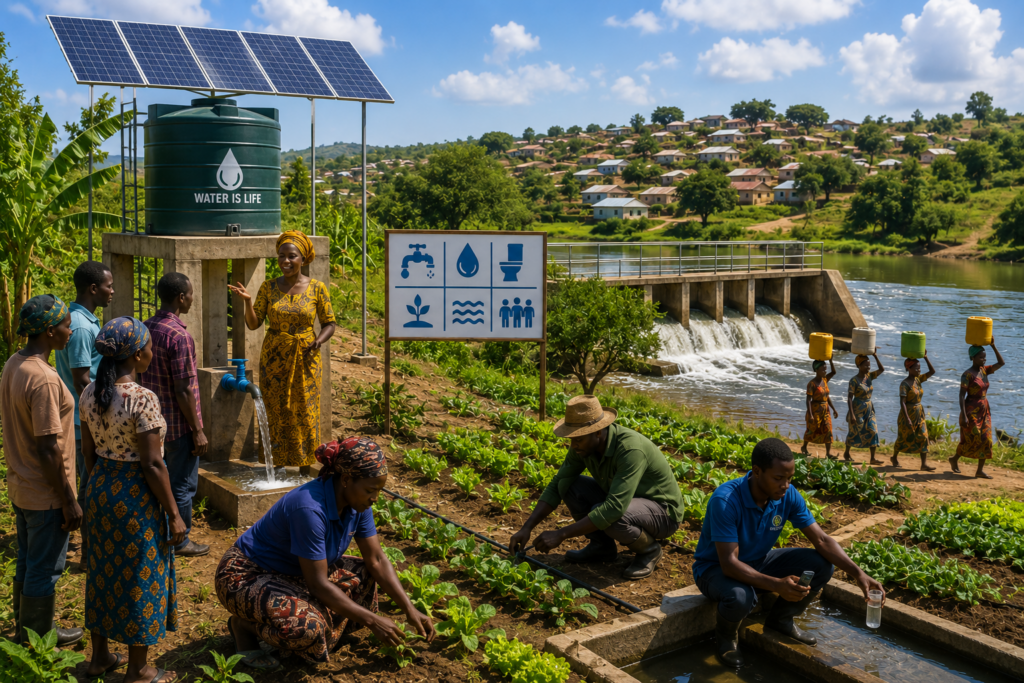
Water security presents both enormous challenges and opportunities across Africa.
Many African countries experience highly variable rainfall, recurrent droughts, rapid urbanization, and growing water demand. Climate change is expected to intensify these pressures through increased temperatures and changing precipitation patterns.
However, Africa also possesses significant opportunities to strengthen water resilience through:
- Climate-smart agriculture.
- Solar-powered irrigation.
- Rainwater harvesting.
- Watershed restoration.
- Sustainable groundwater development.
- Nature-based solutions.
- Digital water monitoring.
- Integrated Food-Energy-Water planning.
Investments in these areas can simultaneously improve food security, rural livelihoods, renewable energy access, and climate adaptation.
Looking Toward a Water-Secure Future
Achieving water security requires recognizing that water is not simply a resource—it is the foundation upon which healthy societies, thriving economies, and resilient ecosystems depend.
Future water management must embrace systems thinking by recognizing the complex interactions among climate, agriculture, energy, ecosystems, public health, infrastructure, governance, and technology.
Convergence science—bringing together engineers, hydrologists, climatologists, ecologists, economists, social scientists, public health experts, policymakers, and local communities—offers an effective pathway toward integrated water solutions.
By combining scientific knowledge, technological innovation, inclusive governance, and sustainable resource management, societies can build resilient water systems capable of meeting future challenges.
Conclusion
Water security is one of the greatest sustainability challenges of our time. As climate change, population growth, pollution, and increasing water demand place greater pressure on freshwater resources, sustainable water management becomes essential for protecting human well-being, supporting economic development, conserving ecosystems, and strengthening climate resilience.
Every community depends upon secure water supplies, whether for drinking, food production, energy generation, healthcare, education, or environmental protection. Building water security therefore requires more than expanding infrastructure—it requires integrated planning, responsible governance, technological innovation, community engagement, and long-term stewardship.
Ultimately, investing in water security is an investment in sustainable development itself. Communities that manage water wisely today will be better prepared to face the environmental, economic, and social challenges of tomorrow.
References
Food and Agriculture Organization of the United Nations (FAO). (2021). The State of the World’s Land and Water Resources for Food and Agriculture – Systems at Breaking Point. Rome: FAO.
Global Water Partnership (GWP). (2000). Integrated Water Resources Management. TAC Background Paper No. 4.
Hoff, H. (2011). Understanding the Nexus: Background Paper for the Bonn 2011 Conference on the Water, Energy and Food Security Nexus. Stockholm Environment Institute.
Intergovernmental Panel on Climate Change (IPCC). (2023). Climate Change 2023: Synthesis Report. Geneva, Switzerland: IPCC.
UNESCO. (2024). United Nations World Water Development Report 2024: Water for Prosperity and Peace. Paris: UNESCO.
UN-Water. (2013). Water Security and the Global Water Agenda: A UN-Water Analytical Brief. Geneva: UN-Water.
UN-Water. (2023). Summary Progress Update 2023: SDG 6 — Water and Sanitation for All. Geneva: UN-Water.

About the Author
Gabriel Sunday Ayayia
Founder, LIFEWS Foundation
Gabriel Sunday Ayayia is a researcher, educator, and systems innovator whose work focuses on agrivoltaics, climate resilience, food-water-energy systems, convergence science, artificial intelligence, and sustainable development. He is currently pursuing a PhD in Biological & Ecological Engineering at Oregon State University, where his research investigates agrivoltaics as a pathway to resilient food-energy-water systems.
Read Full Biography →